An Astrological Interpretation
Then I saw in the right hand of the one seated on the throne a scroll with writing on both sides, sealed with seven seals. (Rev 5:1, CSB)
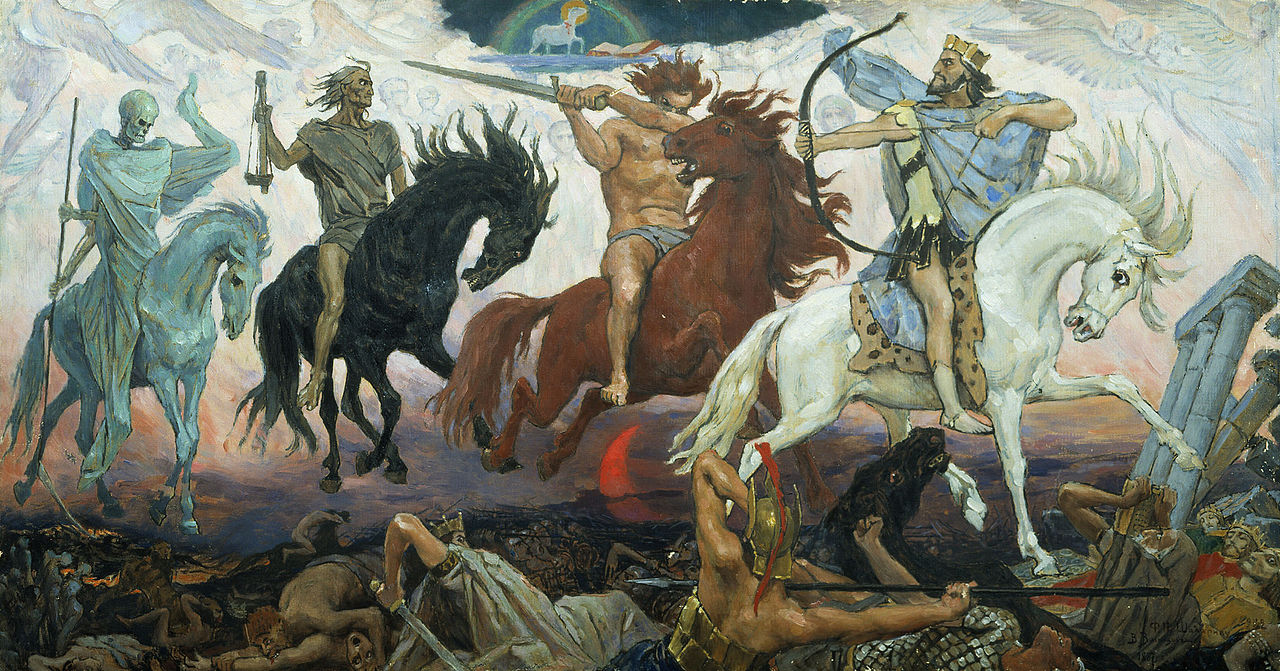
In the book of Revelation, John describes a vision of a scroll in the hand of someone who is seated on a heavenly throne. The scroll contains writing on both sides and is sealed with seven seals. As the seals are opened, John records a series of calamities that unfold on the earth. For each of the first four seals, a horse is identified by color, with a rider who is given specific weapons, objects or powers to wield in judgement. These “horsemen of the apocalypse” have been a source of much speculation and an inspiration for all kinds of fiction. Assuming against a literal interpretation of demonic horse riders flying through the sky, what do these horsemen signify? Do they represent future rulers? Catastrophic events? A traditional futurist interpretation of Revelation treats them as figuratively representing Conquest, War, Famine and Death – events or judgements that will occur at the end of days. But why the elaborate and colorful imagery in which these events are depicted as horses and riders? Is this only a literary device to capture the imagination of the reader, or is there more specific meaning behind each of the symbols in the vision? Many of the details run contrary to what one would expect. Why do only the first four seals in John’s vision contain horses? Why not all seven? And why is the rider named Death riding a green horse instead of the black one? According to the pattern of prophetic interpretation in the Bible, symbols in visions refer to specific persons, places or events. In Daniel, parts of a statue and various beasts refer to specific kingdoms that were to come. In the first chapter of Revelation, John sees seven golden lamp stands and seven stars, which we are told represent the seven churches and their angels (Rev 1:20). We should therefore expect a meaningful and concrete explanation for each symbolic detail in the vision of the seals. A correct interpretation should fit like a key – fully explaining all of the salient details and contradicting none. If no explanation fits this well, we most likely lack the perspective required to fully interpret the passage in question. But, let’s not beat a dead horse, so to speak.
Before diving into the imagery of each seal, let’s first consider the purpose of seals on scrolls in ancient Rome. Seals served to validate and authenticate the rightful owner of an important document. The scroll would have been rolled and tied, and wax seals would have been stamped by signet rings of the author and various witnesses. The seals would be broken and verified at the time the property was to be claimed, and verified by the witnesses that had sealed the scroll to affirm that its contents were authentic and untampered1. Some have speculated that this scroll represents either the property deed or a will that bestows the inheritance of the future kingdom of the earth to Lamb who was slain, an obvious reference to Jesus. In the vision, only the Lamb has the right to break the seals that bring forth the events of the vision and declare his rightful ownership over the world, the saints, and his future kingdom.
I propose that each of the seven seals describes a celestial observation and a set of events that will occur at or around the time of the observation. In computer terms, I think that the events of the vision are astronomically time-stamped. As I will show, this interpretation provides a concrete symbolic explanation for the four horses, their specific colors and the particulars of their riders which is faithful to the original language and follows reasonable clues that can be found in the text. If this is true, celestial signs will serve to validate and authenticate the divine authorship of the vision since only God could arrange heavenly events to coincide with earthly ones. This fits exactly with the spirit and purpose of seals on ancient scrolls, by providing the assurance of authenticity and authorship, as well as the manner in which they are broken at a specific time. I do not suggest the astronomical signs are the only purpose of the passage, but rather that the celestial signs of the seals support and validate the multilayered meaning of the text.
Despite the similarity of objects held by the riders to astrological symbols, I may be the first to propose such an interpretation. That, on the face of it, should make it suspect. How could any plausible idea really come to light after nearly two thousand years of study by millions of Biblical scholars? However, it is possible that the full meaning of this passage may not have been meant to be understood until a time near the end. Only within the last few decades have computers and planetary ephemeris software become widely available so that someone could compute the date of such celestial alignments. If this is a code hidden in Revelation for the final age, it was arguably not meant to be decoded until the technology became available, and the events of the passage were about to unfold. As I will show, we are within a generation of a unique astronomical occurrence described by the symbols in this vision.
Some may balk at the idea of astrological references hidden within the pages of scripture due to their association with pagan religion and divination practices. Modern astrology and horoscopes not only lack scientific basis, but are a form of divination, which is prohibited by Old Testament law and based in a form of pantheistic mythology that runs counter to the Bible. Nevertheless, there are a number of reasons to consider astrology as a relevant language for prophetic visions. Ancient civilizations did not distinguish between astronomy and astrology, and a heritage of storytelling using the sun, moon and stars has been handed down since at least the time of our earliest records. The Old Testament makes multiple references to the constellations, including Ursa Major, Orion, Pleiades (Job 9:9; 38:31, Amos 5:8, Is 13:10). The Hebrew word mazzaroth (מַזָּרוֹת) in Job 38:32 likely refers to the constellations of the zodiac. Scripture does not forbid the association of stars with earthly events. Yes, it speaks against the forms of astrology practiced by the Babylonians (Is 47:13), but no more so than it does of the sacrifices of the Israelites that although prescribed by God were devoid of true worship (Amos 5:21-24, Hosea 6:6, Is 1:11-31). In Genesis 1:14, God states that the sun, moon and stars “will serve as signs for the appointed times and for days and years”, and Psalms 19:1 states that “the heavens declare the glory of God, and the sky above proclaims his handiwork.” In Matthew 2, the wise men followed a star to find Jesus in Bethlehem. In this example, God used the stars to tell his story, and the wise men appear commended by Matthew for using an astrological sign to identify and locate the Messiah. Finally, Jesus and the prophets stated explicitly that there would be signs in the heavens in the last days: “Then there will be signs in the sun, moon and stars; and there will be anguish on the earth among the nations bewildered by the roaring of the sea and the waves.” (Luke 21:25-27)
Horses and Planets
I propose that horses of the seven seals prophecy symbolize planets. The identities of the planets are indicated by the color of the horse, as well as various characteristics of the rider. The riders and the objects that they carry also represent a specific constellation or asterism, and thus a planetary conjunction with the asterism. This idea is inspired by:
- Ancient mythologies have associated celestial bodies with chariots and horses. For example, the Sumerian, Babylonian and Greek solar deities are depicted as driving a chariot with a team of horses across the sky.
- The passage contains multiple symbols known to be associated with asterisms or constellations, including the scales (Libra), the bow (Sagittarius) and the crown (Corona Australis).
- Astrological systems have associated planets with specific colors, due in part to their physical appearance and also according to characteristics of the deities ascribed to each planet.
I focus on astrological associations that would have been known to John. Even assuming the divine origin of the vision, it seems reasonable that God would use symbols that John would understand. These include those of ancient Greek and Roman astrology, but also those of ancient Babylon and Egypt, from which their astrology was largely influenced. Most of the astrology used by the Greeks and Romans was not their own, but rather a retelling and adaptation of symbols, myths and legends that were much older. John’s revelation contains common symbolic references as those of Old Testament prophets including Daniel and Zechariah. For example, Zechariah also describes a vision containing colored horses, possibly with a common symbolic representation. It seems reasonable, then, that Revelation may include prophetic symbols known to the ancient Mesopotamian astrologers as well.
Ancient astronomers knew only of the five planets that are visible with the naked eye, since Uranus and Neptune were not discovered until after the invention of the telescope. A Late Babylonian cuneiform tablet K.2346 (The British Museum, 2025)2 contains an inscription identifying the planets with the exact colors of the horses in Revelation. The inscription and its translation read as follows (Reiner & Pingree, 1998, 248, K.2346+:54)3, quoted in (Makrû – ASE, 2025)4:
Inscription:
mulBABBAR mulSAG.ME.[G]AR
mulSA5 Ṣal-bat-a-nu
mulSIG7 dDil-bat
mulMI dSAG.UŠ: dGUD.UD
Translation:
White star = Jupit[e]r,
Red star = Mars,
Green-yellow star = Venus,
Black star = Saturn, var.: Mercury
This is not the only inscription which contains these color references for the planets, but this tablet is notable in that it includes all of them in a single inscription, much like a cipher or decoding key. If one examines the original meanings of each word and symbol between the Greek and Akkadian symbols, the colors in this Babylonian text align perfectly with those of the horses in Revelation right down to the specific tint or hue.
The First Seal: A White Horse
Then I saw the Lamb open one of the seven seals, and I heard one of the four living creatures say with a voice like thunder, “Come!” I looked, and there was a white horse. Its rider held a bow; a crown was given to him, and he went out as a conqueror in order to conquer. (Rev 6:1-2, CSB)
Jupiter has been associated most consistently with the color white across many astrological systems due to its bright appearance. There are other symbolic clues that point to Jupiter. The rider of the white horse is given a crown, and goes forth to conquer. Jupiter is associated with deities that rule other deities. In ancient Babylonia, the planet Jupiter was associated with the god Marduk, the chief god of Babylon, also known as Bel, or Lord. In Roman mythology, Jupiter is the supreme god, and corresponds to Zeus in Greek mythology. Jupiter represents kingship. And a white horse is a fitting color of steed for royalty.
The rider holds a bow. As a distance weapon, this seems a highly unusual choice for a king, particularly for a conqueror, who might be pictured as leading the charge into battle. Arguably, the natural choice would have been a sword. If we consider the symbolism here as merely abstract, or as a literary device, the choice of weapon is not well explained. The rider with a bow and crown, however, provides a strong and somewhat obvious astrological reference to Sagittarrius. In Babylonian astrology, Sagittarius was associated with a mounted archer, identified with the god Nergal. The Greeks depicted Sagittarius as a centaur archer, sometimes identified with the myth of Chiron, and included within Sagittarius the neighboring constellation of Corona Australis as a wreath-like crown. Corona Australis is also associated with the myth of Dionysus, the god of wine, who is often depicted wearing a wreath. In one story, the god Dionysus made a wreath of myrtle leaves and gave it to Hades in return for his dead mother after retrieving her from the underworld. Chart XV of the Uranographia of Johann Bode (1801) shows Sagittarius drawing his bow. By his forefeet is the constellation Corona Australis depicted as a wreath.

Thus, Sagittarius can account perfectly for both the bow and crown in John’s vision. Wait, but can a wreath really fit the description of the crown in John’s vision? In fact, yes, it absolutely does. The specific word John uses for crown here is stephanos (στέφανος), a woven wreath or garland such as those handed out to the winners of the ancient Greek games, rather than diadema (διάδημα), the royal crown of sovereignty. An alignment of Jupiter with Sagittarius, then, works exceedingly well to satisfy an astrological interpretation of this seal. So John’s use of stephanos here is a perfect fit both to Sagittarius and to a conquering ruler.
John’s use of stephanos over diadema may imply the rider is victorious in battle, gaining or increasing his power through conquest, but it does not preclude a notion of kingship. John also uses stephanos in his depiction of the Son of Man when he is seated on the cloud and holding a sickle prepared to harvest the earth (Rev 14:14). Elsewhere, however, he uses diadema when he refers to the crowns on the heads of the beast and the dragon (Rev 12:3, 13:1), and for another rider of a white horse, the Faithful and True King of Kings and Lord or Lords when he returns to war against the Beast and his armies, and to rule with an iron rod (Rev 19:12).
The Second Seal: A Red Horse
When he opened the second seal, I heard the second living creature say, “Come!” Then another horse went out, a fiery red one, and its rider was allowed to take peace from the earth, so that people would slaughter one another. And a large sword was given to him. (Rev 6:3-4, CSB)
Mars is well known as the red planet due to its physical appearance. Babylonian astrology connected Mars with the Sumerian fire god Girra, leading to an association to both fire and the color red. Babylonian cuneiform uses the symbol mulSA5 to indicate not only red, but specifically a “fiery red”, and also as another name for Mars (SA5 – ASE, 2025)6. The association of the planet with fiery red color is supported by inscriptions such as: mulma-ak-ru-u = tam-šil dGirru(GIŠ.BAR) “Red star = likeness of Girru (= Fire),” quoted in (Makrû – ASE, 2025).
This provides a striking point of correspondence between the astrological symbolism for the planet of Mars and the Revelation 6 passage. While there are multiple Greek words for red, the one used in Revelation 6 is pyrrhos (πυρρός) with the gloss “fiery red, the color of fire” (Mounce, “pyrros”)7. John does distinguish between shades of red, since in Revelation 17:3 he uses kokkinos (κόκκινος) meaning scarlet.
Since earliest recorded times, Mars has been associated with war. Babylonians also associated Mars with their god of war, Nergal. This association with the planet was carried to the Greeks, in the form of Ares and the Romans as Mars. So, in addition to the color symbolism, the depiction of war or violence is a good fit to Mars.
For most modern readers, a sword readily brings to mind the constellation Orion. Orion was not always depicted as carrying a sword, however. In Babylonian astrology, the constellation Orion was known as “The Heavenly Shepherd”, or “The True Shepherd of Anu” and was depicted as carrying a lock and key rather than a sword. The Greek’s depicted Orion as a giant hunter. While some descriptions include a sword in his belt, his most prevalent features were a club and a lion’s skin. In any case, Orion is too far from the ecliptic for Mars to ever reach it.
However, there is one interpretation that fits perfectly. We can find an additional clue if we go back to the original Greek text. John says the rider of the red horse was given a machaira megas (μάχαιρα μεγάλη). Megas means great, or large. But there are two Greek words for sword that are used in the New Testament. The machaira is a knife or short sword with a single edged curved blade, much like a modern machete. The rhomphaia (ῥομφαία) is a longer, often double-edged blade used for thrusting. Some claim that the New Testament authors made no distinction, and machaira is used to refer to a sword generically. This is not supported here, however, since John uses both machaira and rhomphaia, making it clear that he does distinguish between the two. A reference to rhomphaia occurs later in the same passage (Rev 6:8), where it describes the forms of death associated with the fourth seal. Pairing megas with machaira, then, is something of an oxymoron. Rather than describing a great broadsword as we might at first imagine, it is instead describing something akin to a “great curved knife”.
So, is there a great curved machete represented in the stars? Yes, in fact, there is just that. It’s known as Leo’s Sickle, and refers to an asterism in the constellation Leo consisting of six stars that form a backward question mark representing the head and shoulders of the lion, with the star Regulus as the handle. The connection of this asterism to a curved blade has been made since ancient times as well. In a list of constellations, the Roman philosopher Pliny the Elder describes this group of stars as “The Sickle”. The Akkadians referred to it as Gis-mes, the “Curved Weapon,” and in northeastern Persia it was called Khamshish, the “Scimitar.” In the earliest records, the Egyptians referred to this asterism as the “Knife.” (Allen, 1963, 253-255)8 quoted by (Thayer, 2025)9. Thus, a conjunction of Mars with Leo’s Sickle, and particularly with the handle of the Sickle, the star Regulus, provides an excellent astrological fit to the imagery represented by the second seal.
The Third Seal: A Black Horse
When he opened the third sea, I heard the third living creature say, “Come!” And I looked, and there was a black horse. Its rider held a set of scales in his hand. Then I heard something like a voice among the four living creatures say, “A quart of wheat for a denarius, and three quarts of barley for a denarius, but do not harm the oil and the wine. (Rev 6:5-6, CSB)
Babylonian astrologers associated the color black with both Mercury and Saturn, possibly due to their faint appearance. Mercury and Saturn are the two hardest planets to find and identify with the naked eye. In the K.2346 inscription, they are listed together as variants of the term “black-star”. Either planet, therefore, could be a reasonable interpretation for the black horse. Since Jupiter and Mars were associated with various characteristics fitting to their riders, it makes sense to consider whether Mercury or Saturn have associations similarly aligned to the rider of the black horse.
Mercury is the fastest moving planet in the sky. Consequently, it was commonly considered a divine messenger to the gods. For the Babylonians, this was Nabu, the god of scribes, literacy and wisdom. The Greeks called their messenger to the gods Hermes, known to the Romans as Mercury, from which we get the name of the planet. In addition to his role as messenger, Mercury was associated with finance, commerce, travel and deception.
In contrast to Mercury, Saturn is the slowest visible planet in the sky. Thus, ancient astrologers associated Saturn with stability, constancy, and the passage of time. In addition to “SAG.UŠ”, another Babylonian name for Saturn is “TUR.DIŠ” which literally means “constant, unchanging, lasting”, and reflects the slow character of Saturn’s motion relative to the stars (SAG.UŠ – ASE, 2025)10. The planet’s slow and steady pace may have led to its association with agriculture, due either to the slow and steady growth of crops or the marking of seasons critical to determining times to plant and harvest. The Babylonians most often associated Saturn with Ninurta (or Ninib), who was attributed a strong influence on agriculture (Scott, n.d.)11. Because Saturn follows a similar path to the sun, the Babylonians also associated it with the sun and their sun god Shamash, even referring to Saturn as “sun-star” (Jastrow, 1910).
The Greeks associated Saturn with Chronos, the personification of time in Greek mythology and the origin of our concept of Father Time, who is often depicted as holding a scythe. This scythe is a remnant of the association of Chronos to agriculture and harvesting.The Roman counterpart to Chronos is the god Saturn, from which the planet gets its name. Similarly, Saturn was considered a god of time, wealth and agriculture (Saturn (Mythology) – Wikipedia)12.
Traditional interpretations of the black horse associate it with famine and/or extreme inflation, since a quart of wheat is about enough to feed one person for a day, and a denarius is equivalent to a day’s wage. The price of goods described in John’s vision of the black horse bear striking resemblance to ancient Babylonian omens predicting cereal grain prices from observations of planets relative to zodiacal constellations and other phenomena. Both Saturn and Mercury were referenced in such omens, see (Hunger, 1976, 94:7, 15, 47)13, cited by (SAG.UŠ – ASE, 2025), and (Hunger, 1976, 94:24, 28), cited by (GU4.UD – ASE, 2025)14. Saturn, associated with agriculture, aligns well with the concept of famine, but Mercury, associated with commerce, to the concept of inflation.The pair scales held by the rider can be seen as an obvious reference to the constellation Libra. In Babylonian astronomy, Libra was known as “The Scales” or “Balance”, and connected to the god Shamash, a patron of truth and justice. A conjunction of Libra with Saturn and possibly Mercury would represent an astrological fulfillment of the symbolism of the black horse. The two black planets, two sides of the scale, and a pairing between produce and their monetary value suggests the potential of a triple conjunction including both Saturn and Mercury within Libra. In this case, Saturn would represent the agricultural side of the balance, and Mercury the economic side.
The Fourth Seal: A Green Horse
When he opened the fourth seal, I heard the voice of the fourth living creature say, “Come!” And I looked, and there was a pale green horse. Its rider was named Death, and Hades was following after him. They were given authority over a fourth of the earth, to kill by the sword, by famine, by plague, and by the wild animals of the earth. (Rev 6:7-8, CSB)
While the fourth horse has often been associated with plague, this interpretation directly overlooks the other three causes of death mentioned by John, and the fact that plague as a cause of death is mentioned next to last in the list, after both sword and famine. Rather, the primary aspect highlighted by this horse is the vast number of those who have been killed, a quarter of the earth’s population. In this way, the fourth horse can be seen to summarize the deaths related to the first three horses.
The fourth cause of death described here is often translated as “wild animals” or “wild beasts”. However, the original text only uses the word therion (θηρίον), translated elsewhere in Revelation simply as “beast” (Rev 13:1, 13:11). The phrase “of the earth” and the context of death has most likely led translators to adding the interpretive word “wild” here, assuming it refers to animal attacks. Except for some very bizarre scenarios, it is highly unlikely that deaths by wild animals could in any substantial way contribute to billions of fatalities across the planet. Either this includes some type of disease spread by animals, or else beast here refers to the prophetic therion of the earth (kingdoms, nations or rulers) as in Rev 13:11: “Then I saw another beast coming up out of the earth”.
The word used for the color of the fourth horse, chloros (χλωρός), is most commonly translated as either green, or yellow-green, and often refers to the color of fresh vegetation. There are other Koine Greek words that could have been used here, such as prasinos (πρᾰ́σῐνος), meaning leak green, a bolder, possibly darker and less yellowish green than chloros. The word chloros is used four times in the New Testament. The first use is in Mark 6:39, when Jesus tells the people to sit in groups on the green grass before multiplying the five loaves and two fish. The remaining cases are in Revelation, where it refers explicitly to the color of vegetation, trees, plants and grass that are either burned up (Rev. 8:7) or preserved (Rev. 9:4). In the Greek Septuagint, the word is used 16 times. In all cases it is used as the color of vegetation, plants or the like (Krins, n.d.)15.
Green seems an unnatural color for a horse. Thus, most translators for this verse have selected a secondary and much less common gloss for the word chloros: “pale, greenish gray” (Arndt, 2000, 1085)16. Other than the immediate passage, this secondary gloss is supported only by non-Biblical Greek texts. Some of these use the word as an epithet for fear. Others use it medically, such as to describe abnormal skin coloration due to disease. Neither of these uses precludes the implication of a yellow or green tint. The supporting reference from Hippocrates’ Prognostics17 reads “the color of the whole face being green, black, livid, or lead-colored” (Hippocrates, Part 2). Elsewhere Hippocrates uses chloros to specifically refer to a greenish or yellowish hue, as in describing abnormal coloration of spit: “a certain degree of yellowness should appear strongly mixed up with the sputum…that which is very green and frothy is bad…” (Hippocrates, Part 14). If this is the sense of the word here, then a horse of a sickly yellowish green color is implied, possibly without hair, not one that is simply gray.
In Akkadian cuneiform, as well as Greek, there are different color terms that map to what is today referred to as “green” in English. In the previously mentioned Babylonian text, Venus is referenced as mulSIG7, or “(yellow-)green-star”. In Sumerian cuneiform, MUL (𒀯) signifies “star”, “constellation” or “planet”. SIG7 is a color reference. In a table of equivalent color terms for ancient languages, Warburton identifies the Sumerian symbol SIG7 as corresponding to the Greek 1st millennium word “xlōros” (chloros) (Warburton, 2016)18. This provides a direct tie between the color reference used for Venus in the Babylonian text, and that used for the fourth horse of the apocalypse.
For the first three horses, we observed that various astrological or mythological associations of the planets fit those of the rider and their corresponding predicted events. So, besides the color association, does Venus fit additional characteristics related to the green horse? Our name for Venus comes from the Roman deity associated with love and beauty, known to the Greeks as Aphrodite. This certainly does not fit the connotation of Death. However, there is another Roman goddess also associated with Venus. Her name is Libitina, and she was the ancient Roman goddess of funerals and burial. Her name was used metonymically to mean “death” itself, and undertakers were referred to as libitinarii. The sacred grove of Libitini on Esquiline Hill, served as a headquarters for funeral arrangements. This grove contained the Temple of Venus, which collected a “death tax” in the form of a coin for each Roman who died. Consequently, the name Libitinaan was used as another epithet for Venus. During a plague in 65 AD, 30000 deaths were recorded at the Temple of Venus (Grant, n.d.)19. This plague occurred in John’s lifetime and likely before he penned Revelation on the Island of Patmos. The rider of the fourth horse is the only one that John gives a name to. So it seems notable that the rider is said to be named Death, and Libitina is used as another name for death and also for Venus.
There is another possible connection between Venus and death. The Babylonians associated Venus with the goddess Ishtar. In Mesopotamian mythology, Ishtar descends into the underworld, which was ruled by her sister Ereshkigal. At each of seven gates, she is slowly disrobed of articles of clothing, corresponding to her divine powers. When she finally arrives before her sister, naked and powerless, Ereshkigal kills her. She is later rescued by the god Enki, with a price that includes being replaced by her husband. The death and resurrection of Ishtar is often seen as reflecting the cycles of nature, and sometimes interpreted as a symbol of the planet’s cycle as it descends below the horizon as an evening star and reappears as the morning star.
If the fourth seal represents an astrological event, in keeping with the first three horsemen we would expect, then, a convergence of Venus with some constellation associated with death. The rider is named Death. John uses the Greek word thanatos, which is a personification of death, and hades can refer to the Greek god of the underworld, or the realm of the dead. The constellation most associated with death in ancient astrology as well as today is Scorpius. In Greek mythology, the constellation Scorpius is primarily known for its role in the death of Orion, the great hunter. The scorpion was sent to kill Orion after he boasted that he could defeat all the beasts of the earth. Zeus then placed both Orion and the scorpion in the sky as constellations, positioned on opposite sides.
In the vision, Hades follows Death, which implies a potential secondary mover. Is Hades on another horse? In Greek mythology, Hades is the god of the underworld, the realm of the dead. Hades was also used as a general term for the grave or the abode of the dead. This could be seen as a possible reference to Mercury, the Roman equivalent to Hermes. In addition to being the messenger of the gods, Hermes was believed to guide souls through the underworld.
In Egyptian astrology, Scorpius was associated with both death and the goddess Serket, often depicted with a scorpion on her head. She served a role of guardian in the afterlife, protecting the souls of the deceased as they journeyed through the underworld. This role is similar to that of Hades in Greek mythology, who was also thought to rule over the Greek underworld. The ancient Babylonians also saw this constellation as a scorpion and called the constellation MUL.GIR.TAB, which translates to “the creature with a burning sting”. It was associated with the Scorpion Men (Aqrabuamelu) fierce warriors and guardians of the sun, and the underworld. They associated Scorpius with the concepts of death and rebirth, as well as the power of darkness and the decline of the sun’s power after the autumnal equinox.
The Astrological Sign of the Horses
Given such an interpretation, then, we can consider when a convergence of the four (or five) visible planets and their respective constellations will occur. The specific planets representing each horse, and the asterisms or constellations associated with each of the riders are as follows:
| Horse | Rider | Planet | Asterism |
|---|---|---|---|
| White | Conqueror, given a bow and crown | Jupiter | Sagittarius |
| Red | Takes peace from the earth, given a sword | Mars | Leo’s Sickle (Regulus) |
| Black | Holding scales, price of wheat and barley | Saturn and Mercury | Libra |
| Green | Death and Hades | Venus | Scorpius |
Separately, these conjunctions are not infrequent. A conjunction involving all four horses and their respective asterisms at the same time, however, is an extremely rare phenomenon. The determination of when this sign will occur is a relatively simple matter given modern computers and tools for calculating the trajectories of the celestial bodies. Using the Skyfield Python library, I wrote a script to identify dates of such a conjunction. I recommend visualizing these events using Stellarium. The convergence of Jupiter in Sagittarius, Mars in Leo, Saturn in Libra, and Venus in Scorpio occurs only 13 times in the 10,000 year span starting at 0 AD. For all but 4 of these occurrences, Mars is greater than 6 degrees from Regulus, and thus cannot really be seen to be “given the sword” of Leo’s Sickle. Mercury is in Libra along with Saturn for only 4 of the 13 times, and only one of these times does Mars come within 6 degrees of the Sickle. But this single occurrence is the closest that Mars gets to Regulus for all of the 13 occurrences.
On November 3, 2043, all of these signs align perfectly. Jupiter will be in Sagittarius, Mars will be only 1.26 degrees from Regulus, Saturn and Mercury will both be in Libra, and Venus will be in Scorpius. This is the only time all of these alignments occur together in the space of 10,000 years! Mars actually gets slightly closer to Regulus (1.21 degrees) a day later, but November 3 provides the best alignment with the handle of the Sickle. Additionally, if you advance the clock a few days starting around November 8 Mercury can be seen to follow Venus through Scorpio just as it says in Rev. 6: “and Hades was following after him.”
The image below was generated using Stellarium showing the convergence.

The Fifth Seal: Souls of Martyrs under the Altar
When he opened the fifth seal, I saw under the altar the souls of those who had been slaughtered because of the word of God and the testimony they had been given. They cried out with a loud voice, “Lord, the one who is holy and true, how long until you judge those who live on the earth and avenge our blood?” So they were each given a white robe, and they were told to rest a little while longer until the number would be completed of their fellow servants and their brothers and sisters, who were going to be killed just as they had been. (Rev 6:9-11, CSB)
Astrological symbolism is less apparent in the fifth seal. But, since the sixth seal refers explicitly to the sun, moon and stars (Rev 6:12-13), and the seventh seal is silence in the heavens, it raises the question whether potentially all the seals refer to celestial events. In the fifth seal, John sees an altar and souls under the altar which represent martyrs who have been killed because of their testimony to the word of God. There is a lot of rich spiritual significance in the symbolism here that goes back to the Old Testament sacrificial system and the first fruits offerings. The martyrs in Christ are a kind of first fruits offering (Jam 1:18), thus tying this seal to the concept of a final harvest of the earth in which the wheat will be separated from the tares at the end of the age (Matt. 13:24-30). The harvest is a theme throughout Revelation, and all of Scripture in fact, which is why the Son of Man is depicted as holding a sickle and is told to reap for the time of the harvest is come (Rev 14:14). This is all too much to go into detail here, but I don’t want the reader to miss the relevance of the symbolism that extends well beyond any astrological reference. But, for the current discussion let’s focus on a possible astrological sign that could fit this passage as well.
An obvious choice of an astrological reference is the constellation Ara, Latin for Altar. It is a southern constellation located between Sorpius, Telescopium and Norma. The Greeks identified it with various mythological stories, including an altar used by the Greek gods to swear an oath of allegiance against Chronos and the Titans. It is too far from the ecliptic for any planetary convergence. But as there are no horses referred to in this seal, a planetary conjunction would contradict our horse-planet hypothesis in any case. The souls are given white robes. The altar is near the Milky Way, which could be considered tone-like, but since the location of the Milky Way in relation to the stars is static from our perspective, this does not make much of a sign.
Digging a little deeper into the history of Ara, however, it turns out that what is currently identified as Ara is not the original asterism known as an Alter from antiquity. Rather, there are numerous points of evidence that the Greeks or Romans adopted the concept of an Altar from ancient Akkadian astronomy and moved it from its original location near the ecliptic. Possibly the modern location wasn’t set until the 18th century. As one point of evidence among others, the Akkadian words for the months are based on an ancient form of the zodiac. The seventh month is Tul-Ku, meaning “holy mound” or altar, which would indicate its original position to be near the current location of Libra. Libra was not identified as the Scales by the Akkadians, but the concept of weighing of souls in the underworld appears to be tied to Akkadian mythology of the altar, or sacred mound, and later similar concepts of souls being weighed for their earthly deeds naturally became associated with Libra, the Balance or Scales and to concepts of justice and fairness. It seems appropriate, then, to look near Libra for fulfillment of this sign rather than Ara since the Libra asterism has association to both the altar and the concept of justice and fairness for souls after death. The souls of the martyrs here call out for justice as they are weighed because their blood was shed unjustly for their testimony to the truth of God’s word.
So what celestial phenomenon looks like a robe, moves in relation to the stars, and is not a planet? A comet! Actually, multiple comets. At the precise time of convergence as the previous four seals, early November 2043, a periodic comet known as 73P/Schwassmann-Wachmann will be swinging into Libra. And this is not a typical comet. During its previous few passes by earth every 5.4 years the comet has broken into multiple pieces, now over 34 fragments each with a glowing comet tail. Each time this fragmentation happens there appears to be an increase in brightness. Currently, there are now over thirty “comet-lets”, as can be seen in this Hubble image. Undoubtedly, these do look like images of multiple stars with robes. Note that stars are one of the symbols associated with God’s saints (Phil. 2:15).

Here is the dated view of the sky forecasted by Stellarium showing the 73P fragments as they enter the region of Libra in 2043.

The presence of such an unusual comet at this exact time and location already identified by the four horsemen provides an amazing additional verification of the deeper meaning behind the vision of the seals. The first four seals are enough to uniquely identify a single date in all of human history. I will leave it to the reader to consider the improbable likelihood of a robe-like comet show occurring by chance on top of these previous signs.
The Sixth Seal: Sun, Moon and Stars
Then I saw him open the sixth seal. A violent earthquake occurred; the sun turned black like sackcloth made of hair; the entire moon became like blood; the stars of heaven fell to teh earth as a fig tree drops its unripe figs when shaken by a high wind; the sky was split apart like a scroll being rolled up; and every mountain and island was moved from its place. (Rev 6:12-14)
The sixth seal contains direct reference to a celestial event involving the sun, moon and stars. I interpret this to be literal, and like the other seals reference signs in the sky. There are many references to this same event throughout scripture. Presumably, this event will occur soon after the previous sign, or in conjunction. Based on the events described in the sixth seal, and the seventh trumpet, it may well be caused by a major catastrophic event such as an astroid collision or a nuclear detonation, and referenced by the star Wormwood falling from heaven like a torch. The sign is one that Jesus referenced as directly preceding his second coming (Matt. 24:29). An observant reader will identify many similar event occur in both the sixth seal and the vision of the trumpets. As a point of discussion for another day, I do not see the seals occurring before the trumpets, but rather at the same time. The seals are a perspective of the same end-times events as the trumpets, but in relation to the celestial signs and they tie the judgements to the signs in the heavens.
The Seventh Seal: Silence in Heaven
When he opened the seventh seal, there was silence in heaven for about half an hour. (Rev 8:1)
Given the way the chapters have been grouped, many take the seventh seal to include the vision of the seven trumpets that follows directly in chapter 8. Note, however, that chapter breaks are not inspired and were added by scholars much later than the original text. I take a less common view that this verse is the totality of the seventh seal. After all the signs have been displayed, there is now silence in heaven. Mic drop. But in any case, note that the seventh seal is also a heavenly sign. The Greek word for heaven can mean sky or a spiritual abode. Maybe it means both here, given the other celestial signs. What it means for the sky to be silent for half an hour may simply be the result of the sixth seal in which the signs placed in the sky (sun, moon and stars) are darkened for a half hour of prophetic time, which is much longer than natural time and probably hard to say exactly how long. There are at least two types of prophetic time. If one day equals a thousand years (2 Peter 3:8) then a half hour is around 21 years. If a day equals a 360 day prophetic year, then a half hour is 7.5 days. Or, this may refer to a solar eclipse, with totality that lasts for about 30 actual minutes. Solar eclipses are not rare, and occur about every year, so I would lean to the prior explanation. Or, possibly, this refers to a completely different type of sign that we could not predict but we will know when the time comes.
A Point of Clarification
In the interpretation I have put forth, I base the planetary conjunctions on astrological symbols associated with each horse in the same passage in Revelation 6. Another popularized view ascribes them based on the living creatures that call forth each horseman, where the living creatures are taken to be cardinal signs of the zodiac21. This alternate interpretation yields a date in 81AD that supports a preterist interpretation of Revelation as describing past events. The notion that the four living creatures, also described in Ezekial, refer to zodiacal signs has been around for a long time but is a problematic one. While some of the living creatures are similar to zodiac signs, such as the one with the face of an ox, others appear force-fit. The one with a face of a man is taken as Aquarius. There are many signs which have been depicted with human form, so why this specific sign? The creature appearing as an eagle is assigned to Scorpius, yet another constellation is actually known as the Eagle (Aquila) and the association of Scorpius with an eagle is tenuous at best. Scorpius has been associated with a scorpion since at least as far back as the ancient Akkadian texts. The creatures are not specified in Revelation 6, so it cannot be determined which creature calls which horseman. Most importantly, perhaps, this alternate view does not give explanation to the other symbolic details of the vision including the astrological symbols of the bow, the crown, and the scales since they are not used to identify the planetary alignments.
Conclusion
Go your way, Daniel, because the words are rolled up and sealed until the time of the end. Many will be purified, made spotless and refined, but the wicked will continue to be wicked. None of the wicked will understand, but those who are wise will understand. (Dan 12:9-10, NIV)
There remains ambiguity as to what the date of this alignment represents. Dates derived from Biblical prophecy should be regarded with a healthy dose of skepticism and distrust, particularly for future dates. Eventually, these are usually proven wrong, and in the meantime they can generate a great deal of false hype. With regards to the date of his second coming, Jesus himself warned that “no one knows the day and the hour when these things will happen, not even the angels in heaven or the Son himself. Only the Father knows” (Matthew 24:36). Regarding whether we can know the date and time, we are thus fairly cautioned. I do not claim this is the date of Christ’s second coming. It may relate to events of the apocalypse that precede his return. While the time of this astronomical event may be calculated to an exact time of closest convergence the planets move relatively slowly. Thus, this astronomical timestamp does not give us the day or the hour, or even the exact month of any event, only the approximate time to a period of days or weeks. But when it comes, I expect that we will be able to understand its significance. Jesus indicated we could and should know the season of his return. In Luke 29, he described the parable of the fig tree, and the ability to identify the season of figs based on the time the leaves emerge. “In the same way, when you see these things happening, recognize that the kingdom of God is near” (Luke 29:31). Luke 29:28 says “But when these things begin to take place, stand up and lift your heads, because your redemption is near.”
At the time of this writing, there is war in Israel in Ukraine and some points of interpretation may be even more clear in the near future. We should be vigilant and ready to understand the significance of the events when the time occurs, and ready to give testimony to the truth. These prophecies are intentionally obscure (sealed) so that at the right time, and by the right people, they can be used to authenticate and provide perspective and instruction for a generation that needs them. At the appointed time, it will be clear to those who are wise. May God give you the wisdom to understand, and may you find your hope and salvation in the return of our Savior.
References
- Richards, E. R. (2016, July 21). A Scroll with Seven Seals. Biblical Thoughts. https://randolphrichards.com/2016/07/21/a-scroll-with-seven-seals/ ↩︎
- The British Museum. (2025). Series: Library of Ashurbanipal. Tablet K.2346. Retrieved June 12, 2025, from https://www.britishmuseum.org/collection/object/W_K-2346 ↩︎
- Reiner, E., & Pingree, D. (1998). Babylonian Planetary Omens: Part Three. STYX Publications. ↩︎
- Makrû – ASE. (2025, May 27). All Skies Encyclopaedia. Retrieved June 12, 2025, from https://xing.fmi.uni-jena.de/mediawiki/index.php/Makr%C3%BB ↩︎
- Jacopo Montano, CC BY-SA 3.0 http://creativecommons.org/licenses/by-sa/3.0/, via Wikimedia Commons, from https://commons.wikimedia.org/wiki/File:Sagittarius.jpg ↩︎
- SA5 – ASE. (2025, June 1). All Skies Encyclopaedia. Retrieved June 12, 2025, from https://xing.fmi.uni-jena.de/mediawiki/index.php/SA5 ↩︎
- Mounce, B. (n.d.). Greek Dictionary. https://www.billmounce.com/greek-dictionary/ ↩︎
- Allen, R. H. (1963). Star names: Their lore and meaning. Dover. ↩︎
- Thayer, B. (2025, March 20). Retrieved June 12, 2025, from https://penelope.uchicago.edu/Thayer/E/Gazetteer/Topics/astronomy/_Texts/secondary/ALLSTA/Leo*.html ↩︎
- SAG.UŠ – ASE. (2025, June 1). All Skies Encyclopaedia. Retrieved June 14, 2025, from https://xing.fmi.uni-jena.de/mediawiki/index.php/SAG.U%C5%A0 ↩︎
- Scott, D. (n.d.). Ninurta – Wikipedia. Wikipedia, the free encyclopedia. Retrieved June 14, 2025, from https://en.wikipedia.org/wiki/Ninurta#CITEREFKoch1995 ↩︎
- Saturn (mythology) – Wikipedia. (n.d.). Wikipedia, the free encyclopedia. Retrieved June 14, 2025, from https://en.wikipedia.org/wiki/Saturn_(mythology) ↩︎
- Hunger, H. (1976). Špätbabylonische Texte aus Uruk (Vol. I). Berlin. ↩︎
- GU4.UD – ASE. (2025, May 24). All Skies Encyclopaedia. Retrieved June 22, 2025, from https://xing.fmi.uni-jena.de/mediawiki/index.php/GU4.UD ↩︎
- Krins, B. (n.d.). The Green Horse. Retrieved June 22, 2025, from https://christenvandaag.nl/en/Biblestudy-NT/The-green-horse ↩︎
- Arndt, W. F. (2000). A Greek-English lexicon of the New Testament and other early Christian literature (W. F. Arndt & F. W. Danker, Eds.). University of Chicago Press. ↩︎
- Hippocrates. (n.d.). Prognosticon. https://www.perseus.tufts.edu/hopper/text?doc=Perseus:text:1999.01.0248 ↩︎
- Warburton, D. A. (2016). Ancient Color Categories. In Encyclopedia of Color Science and Technology (pp. 24-31). Springer New York. https://sites.socsci.uci.edu/~kjameson/ECST/Warbuton_AncientColorCategories.pdf ↩︎
- Grant, M. (n.d.). Libitina | Goddess of Death, Burial & Funerals. Britannica. Retrieved June 22, 2025, from https://www.britannica.com/topic/Libitina ↩︎
- NASA, ESA, H. Weaver (APL/JHU), M. Mutchler and Z. Levay (STScI), from https://science.nasa.gov/image-detail/comet-73p/ ↩︎
- https://bretpowelljr.substack.com/p/astrology-the-four-beasts-and-the?utm_campaign=post&utm_medium=web ↩︎

Leave a Reply